
This is an archive of Physics 10 essay questions. The last semester these questions (and answers) were used was in Spring 2021 class, and with the recent re-organization of the course material, I don’t anticipate using them again, so this is a kind of “resting place” for this material.
Organization of the Archive
The archive is organized as a direct copy of the essay assignments from the old course Canvas shell, with links corrected as necessary. Each H2 heading holds the topic area (e.g. “Chapter 1: Kinematics”) and under that heading, the first H3 heading contains the essay assignment, and the second H3 heading contains the peer review assignment, which also contained the model answers.
The instructions for the essay assignments are repeated each time (although, sometimes with a variation, hence the reason for repetition here even when the instructions don’t deviate from the standard template). For the peer review assignment, the full set of instructions will be listed the first time (for “Chapter 1: Kinematics”), and the subsequent peer review assignments will only list the model answers (assume similar instructions as the first time, mutatis mutandis).
Chapter 1: Kinematics
Essay Assignment for “Chapter 1: Kinematics”
In this essay assignment, you will see an important principle of projectile motion demonstrated. Please watch the following physics demonstration video from Harvard Natural Sciences Lecture Demonstrations and answer some of the questions below:
For the essay assignment, consider following 4 questions and choose 2 to answer.
- In one paragraph, explain what happens with the two balls. What happened with the demonstration that was interesting? What do you think is the physical principle being demonstrated through this example? Why do you think the balls move in the way you saw and strike the ground in the way you saw?
- Consider the following statement: “In this shoot-n-drop demo, the two balls have different velocities, compared to the other ball, throughout their motion, but they have the same accelerations, compared to the other ball, throughout their motion.” Is this a true statement? Justify your answer by pointing out particular features you noticed in the video and by using the physics definitions of velocity and acceleration.
- Imagine this experiment was carried out so that the ball being shot out to the right was shot out twice as fast as seen in above video. Will both balls still strike the ground at the same time? Explain why or why not, and make sure to explain what changes and what doesn’t change.
- For this question, look at the following additional video, demonstrating the classic “shoot the monkey” experiment:
To briefly explain what is going on: (1) the launcher is aimed directly at the monkey (by aligning the laser sight to the monkey); (2) at the push of a single button, simultaneously, the monkey is released and the ball is fired; and (3) even though monkey drops from where he was when the launcher fired, he still manages to get hit by the ball.
So, here are the questions I want you to address in your answer: Why was the monkey hit by the ball? Would the monkey have been hit if he continued to hold on, staying where he was? If the ball was fired at a faster speed or slightly slower speed, will it now miss the monkey?
As you answer, make sure your answer to this assignment addresses 2 of 4 questions posed above. This is a peer-graded assignment, so please make sure your peers can understand what you wrote (you yourself will review answers by 3 of your peers).
To make a submission, click on “Submit” button at the top of the page. I encourage you to use the “Text Entry” option to type in your answers. Other submission options are enabled in case you need to include a diagram or a photo, but the text entry option is what I recommend. (Note: If you need to change anything in your submission, you can click on “Re-Submit” button to replace your previous submission.)
Peer Grading for “Chapter 1: Kinematics” Essay Assignment
Model Answers
Following are model answers to the questions in Essay Assignment for “Chapter 1: Kinematics”:
- “In one paragraph, explain what happens with the balls”: In the demonstration, you see two balls falling. However, the ball on the right is given an initial rightward horizontal velocity, while the ball on the left is dropped from rest. Despite this difference in the initial horizontal velocities, you see both balls hitting the ground at the same time, because both balls have the same vertical velocities (from the start to the end), experience the same vertical gravitational acceleration, and the motion in vertical and horizontal directions are independent.
- Evaluation of statement, “In this shoot-n-drop demo, the two balls have different velocities, compared to the other ball, throughout their motion, but they have the same accelerations, compared to the other ball, throughout their motion.”: This is a true statement, in particular to the second part, since the two balls have the same accelerations: vertical, downward gravitational acceleration at about 9.8 m/s2. The first part requires a little qualification. The two balls have the same vertical velocity throughout their motion (they both start out not moving vertically). They have different horizontal velocity in their motion (the ball on the right start out with some; the ball on the left start out with none). One could correctly summarize this as “hav[ing] different velocities,” but a pickier individual might clarify which components of velocities are the same and which are different (and on the basis of this distinction, evaluate the statement as not being completely correct).
- “Will both balls still strike the ground at the same time [if the ball on the right is shot out faster]?”: Yes, because the motion in horizontal and vertical directions are independent. Additional horizontal velocity does not change the vertical motion of the ball that is being shot out, so it still strikes the ground at the same time as a ball being dropped. Initial vertical velocity is not changing (and this is important in ensuring both balls drop at the same time).
- “Shoot-the-monkey demonstration”: The monkey is hit by the ball because, in some sense, both the ball and the monkey “fall” under gravity by the same amount in the time it takes for the ball to travel to the monkey’s location. In the case of the monkey, it is falling literally (from its starting position). In the case of the ball, it is “falling” as compared to a straight-line trajectory it would have moved in, in the absence of gravity. Remaining answers: (1) The monkey would not have been hit if he continued to hold on (the ball “falls” but the monkey does not), (2) As long as the ball was fired fast enough to hit the monkey before it hits the ground, it would hit the monkey whether it is fired at a faster or slower speed.
Important Notes
For a peer review to be considered complete, you must fill out the grading rubric, and leave some helpful comments. You can find the assigned peer reviews on the essay assignment page (Essay Assignment for “Chapter 1: Kinematics”). Peer grading is anonymous between peers, but the instructor sees all names.
In grading your peers, please remember you can only assign a score of 0 or 1 for the correctness of the answer you are reading. This is what it means:
- Score of “0” means the answer you are reading is completely off base. It might even say something that is directly contradictory to the key idea (key ideas are in bold and italicized font).
- Score of “1” means the answer you are reading is mostly right. It might say some things that are not quite right, but it got the key idea correct.
Please contact me if there are any questions, and please remember to complete the peer reviews on time. You will receive 1 point (up to 3 points total) on this no-submission assignment for each completed peer review after the peer review due date.
Late Peer Reviews
There is some limited grace period between the peer review due date and when I assign peer review scores. Beyond this, please note there will be no extensions. Peer reviews must be received on time for them to be useful to the people you are reviewing. If you do not see any peer reviews assigned to you and it’s past peer review deadline, it’s because I removed all incomplete peer review assignments when I gave peer review credit.
“Mark as Done”
You must mark this assignment as done before you can move onto the next page in the module. In this class, “mark as done” simply means you take responsibility for knowing the information on the page (whereas “view” requirement simply means your web browser accessed the information). So, if you feel you understood what is on this page and you take responsibility, please mark it as done, so that you can move on to the next page.
Chapter 2: Dynamics
Essay Assignment for “Chapter 2: Dynamics”
In this essay assignment, you will see a couple unusual situations dealing with forces, which will help highlight common, intuitive mistakes students make in applying Newton’s Laws. Please watch the following two videos and answer some of the questions below:
For the essay assignment, consider following 4 questions and choose 2 to answer.
- Describe what you see in the “Zero-G Flight” video. What happens to the passengers as the airplane falls with the pull of gravity from Earth? Explain how the zero-G flight (which flies no higher than regular commercial jetliners) is different from regular airplane flights you may have been on (and felt no sensation of weightlessness).
- In the “Zero-G Flight” video, the narrator describes, “gravity is completely gone away.” Is this statement true, in the sense that there is no more gravitational pull by Earth on the passengers on the flight? If there is still gravitational pull by Earth on the passengers on the flight, why do the passengers feel weightless? What force do the passengers (and we, on the ground!) feel as apparent weight that these passengers no longer feel? (As a side comment: the narrator says “I’ve cancelled gravity out.” This is in reference to Einstein’s equivalence principle, which we may touch on briefly in relativity. For the moment, it is more instructive to think about this situation by considering only the real forces on the passengers.)
- In the second video, of astronauts doing a simple experiment, Flight Engineer Rick Mastracchio pushes Expedition Commander Koichi Wakata (and the shuttle model he holds) forward towards the camera and he himself is seen moving backward away from the camera. Explain in one short paragraph how this is explained by Newton’s Third Law (it helps to state what Newton’s Third Law is).
- For a space shuttle in the vacuum of space, explain how the shuttle would propel itself forward. What gets pushed backward, so that the shuttle is pushed forward? Identify the action force and the reaction force in this interaction, and please be specific (for both the action force and the reaction force) which object is exerting the force, and which object the force is being exerted on.
As you answer, make sure your answer to this assignment addresses 2 of 4 questions posed above. This is a peer-graded assignment, so please make sure your peers can understand what you wrote (you yourself will review answers by 3 of your peers).
To make a submission, click on “Submit” button at the top of the page. I encourage you to use the “Text Entry” option to type in your answers. Other submission options are enabled in case you need to include a diagram or a photo, but the text entry option is what I recommend. (Note: If you need to change anything in your submission, you can click on “Re-Submit” button to replace your previous submission.)
Peer Grading for “Chapter 2: Dynamics” Essay Assignment
Model Answers
Following are model answers to the questions in Essay Assignment for “Chapter 2: Dynamics”:
- “Describe what you see in the ‘Zero-G Flight’ video”: The passengers appear to float within the plane as the airplane falls with the pull of gravity (i.e. as it goes into “free fall“). The zero-G flight is different from regular airplane flights, specifically in that it flies in parabolic arcs, designed so that in certain segments of the flight, the airplane is accelerating downward at 9.8 m/s2, like an object in free fall. Although the passengers are also accelerating downward (passengers are also in free fall), because both the airplane and the passengers are accelerating downward together, they don’t appear to be falling relative to the airplane (but the gravity has not actually gone away, as described below for Question 2).
- Is it true “gravity is completely gone away”?: No, not in the sense that the gravitational force is gone. Specifically, Earth’s gravitational pull is still pulling the passengers and the airplane downward (which is why they are both accelerating downward at 9.8 m/s2). The passengers feel weightless because there are no more contact forces on them. There is no more normal force (also known as “support force” or “apparent weight”) on the passengers from the airplane; because the airplane is accelerating downward at the same rate as the passengers, it does not need to push the passengers up. (Note: some answers might draw an excellent comparison to skydiving, where the skydiver feels the air resistance—so they don’t feel quite weightless—but here as the air moves with the airplane, the passengers do not feel air resistance and experience a sensation closer to true weightlessness. But this comparison is not required for an answer to be considered correct.)
- Explain the astronauts’ motions using Newton’s Third Law: Newton’s Third Law says that for every action (force) there is an equal and opposite reaction (force). But a clearer (if longer) statement is this: For every force object/person A applies on object/person B (“action force”), B applies an equal magnitude of force on A in opposite direction (“reaction force”). In the video, FE Mastracchio pushes EC Wakata in the forward direction (so EC Wakata accelerates forward). So according to Newton’s Third Law, even though he is completely passive, EC Wakata is pushing FE Mastracchio back in the backward direction (you might call this “reaction force”), so FE Mastracchio accelerates in the backward direction. Newton’s Third Law ensures that these two forces are equal in magnitude, and since they have roughly the same mass, their accelerations (given by Newton’s Second Law) are also roughly same.
- Explain how the shuttle propels itself forward: A shuttle (or any rocket) propulsion works through Newton’s Third Law. The shuttle’s engine is designed in such a way (we will skip over the details) so that when combustion happens in it, the reaction products (water vapor and other gases) are pushed backward. If we call this (shuttle pushing its burnt fuel backward) “action force,” then the reaction force is the force of the burnt fuel pushing the shuttle forward. It’s this reaction force that pushes the shuttle forward, and as you can see, the shuttle carries with itself the object that it pushes backward (its own fuel), and it doesn’t need to push on anything outside of itself (not the ground and not the atmosphere), both in the vacuum of space and in the atmosphere.
Chapter 3: Work and Energy
Essay Assignment for “Chapter 3: Work and Energy”
In the following video, you will see an illustration of conservation of energy, one of the two bedrock conservation principles you will learn in mechanics. Please watch the following lecture demonstration video and answer below two questions.
Questions:
- In the video, the professor “risks his life” in demonstrating conservation of energy, by showing that the pendulum (or “wrecking ball”) will not crush his chin. How is it that, just prior to his demonstration that did not crush his chin, the pendulum did shatter the window that was mounted on the frame that he removed? Please explain what the key difference must have been, in order for the wrecking ball to shatter the window on its return journey.
- If you watch the video carefully, you will notice that the wrecking ball actually does not even touch the professor’s chin (it comes within a few centimeters of touching it). Assuming the wrecking ball was indeed released from rest while touching the professor’s chin (and his chin did not move back, since there was no room for him to), can you explain why the wrecking ball did not return to its original height? What processes are responsible for this loss of mechanical energy?
As you answer, please make sure you answer both questions above. This is a peer-graded assignment, so please make sure your peers can understand what you wrote (you yourself will review answers by 3 of your peers).
To make a submission, click on “Submit” button at the top of the page. I encourage you to use the “Text Entry” option to type in your answers. Other submission options are enabled in case you need to include a diagram or a photo, but the text entry option is what I recommend. (Note: If you need to change anything in your submission, you can click on “Re-Submit” button to replace your previous submission.)
Peer Grading for “Chapter 3: Work and Energy” Essay Assignment
Model Answers
Following are model answers to the questions in Essay Assignment for “Chapter 3: Work and Energy”:
- “How is it that … the pendulum did shatter the window?”: The key difference here is whether the professor gives the ball an initial push (hence some initial kinetic energy) or not. When he wanted to smash the window, he gave the ball a little push and initial kinetic energy, meaning that the ball had enough energy to go higher than its initial height, smashing the window. When he did not want to smash his own chin, he took great care to release the ball from complete rest (as he took great pains to describe), so with zero initial kinetic energy, the ball does not have enough energy to go higher than its initial height (the position of maximum potential energy).
- “Can you explain why the wrecking ball did not return to its original height?”: What we are looking for is friction and air resistance, as the culprit that reduces the total energy of the pendulum. Whenever you see mechanical energy not conserved, chances are, very often, you can blame it on friction (and air resistance, which is a form of friction). This is why we took some time to describe friction when we described forces. In physics, we often like to describe things in idealized setting where friction is zero. But when we make comparisons to real-world objects, we have to remember that there is almost always some friction around (it is very difficult to make it exactly zero).
Chapter 4: Impulse and Momentum
Essay Assignment for “Chapter 4: Impulse and Momentum”
One of the areas in science and engineering where a good understanding of physical concepts of impulse, momentum, and Newton’s Third Law is indispensable is rocket propulsion. Following three videos give some details of rocket propulsion, from chemical rockets which were used for Apollo moon missions (and are continuing to be used for satellite launches, supply missions to the ISS, etc.) to ion engines, which some hope will be the prime mover of future space exploration.
Please watch these videos and answer below two questions. The third video is a bit long; you should be able to answer the questions without having watched the entirety of the last video.
Questions:
- In multi-stage chemical rockets, earlier stages (starting with solid-fuel rocket booster) are separated from the later stages (and eventually the payload) after the fuel is exhausted. In terms of Newton’s Laws, conservation of energy, and/or ideas of impulse and momentum, explain how this multi-stage design is better than single-stage design (what might have been called “single-stage-to-orbit” design). The first video gives a little hint (with reference to mass); expand on that passing remark in your explanation.
- In the videos for ion engines, following statement (paraphrased) is made: “Large velocity of ions being pushed outward generates a very efficient production of thrust (or propulsion).” Explain, in terms of conservation of momentum, why that is (also explain as necessary what “efficiency” here is referring to).
As you answer, please make sure you answer both questions above. This is a peer-graded assignment, so please make sure your peers can understand what you wrote (you yourself will review answers by 3 of your peers).
To make a submission, click on “Submit” button at the top of the page. I encourage you to use the “Text Entry” option to type in your answers. Other submission options are enabled in case you need to include a diagram or a photo, but the text entry option is what I recommend. (Note: If you need to change anything in your submission, you can click on “Re-Submit” button to replace your previous submission.)
P.S. I wanted to ask something about “gravitational slingshot” or “gravity assist,” but I think that would be too much work considering everything. So, let me just share this video without requiring any additional work (… at least for this semester):
Peer Grading for “Chapter 4: Impulse and Momentum” Essay Assignment
Model Answers
Following are model answers to the questions in Essay Assignment for “Chapter 4: Impulse and Momentum”:
- “How is the multi-stage design better?”: As the first video describes (at about 3:15 mark), each spent stages are abandoned in order to reduce weight and make it possible to achieve greater acceleration. Now, here is a detailed explanation using (a) Newton’s Laws, (b) impulse and momentum, and (c) conservation of energy. It is not necessary for a correct answer to use all these approaches, but a correct answer should include at least one approach in the detailed explanation:
- Newton’s Laws: This is a simple application of Newton’s Second Law. If each stage of rocket can produce a fixed amount of thrust (force), then the lighter you can make the mass of the rocket, the more acceleration you will get, and the more acceleration, the higher velocity and higher orbit you can achieve (note: here, it is important to distinguish mass from weight; it’s the mass that matters directly). So in order to do that, the “dead weight” from earlier, spent stages are discarded, so that these useless parts are not accelerated along with the “payload” that we want to put in orbit.
- Impulse and momentum: Conservation of momentum holds in rocket propulsion. By pushing out rocket propellants in one direction with great momentum, the remaining rocket is propelled in the other direction with equal momentum (keeping net change in momentum zero). So, given the same amount of momentum (
 ) given to the remaining rocket, the less massive we can make the “remaining rocket,” the more velocity it would gain. So the dead weight from earlier, spent stages are discarded.
 - Conservation of energy: The process of putting the rocket payload in orbit is essentially a process of putting in enough energy into this mass to have gravitational potential energy necessary to achieve the orbital height (it also needs velocity in the correct direction, etc., but we are ignoring that detail for now). Since gravitational potential energy is proportional to mass, the smaller we can make the mass of the objects we push up to a particular height, less energy will be needed to place the eventual payload in the orbit. So, as soon as parts of the rocket are not needed (i.e. earlier stages with spent fuel), they are discarded so that the dead weight does not need to be dragged up to higher heights (which wastes energy).
- “Why is large velocity needed for efficient production of thrust?”: The basic principle of rocket propulsion is the same across all propulsion methods that work in space: you throw a part of the rocket backward, and the reaction force pushes the remainder of the rocket forward (Newton’s Third Law and conservation of momentum). Since there is a limited amount of rocket (except in some special designs where the rocket collects surrounding material), you want to achieve the biggest “bang for the buck,” and here the “bang” (i.e. what you get) is the impulse you gain for the “remainder of the rocket” and the “buck” (i.e. what you pay) is the amount of mass you have to throw. From conservation of momentum, impulse gained for the rocket is equal in magnitude to the impulse carried away by the propellant (
 ), and the greater the speed of the propellant, the less mass you need to eject, in order to achieve the same thrust. This is the sense in which chemical rockets are inefficient (the propellant velocity isn’t very high, compared to speed of light, so mass ejected is very large) and ion engines are efficient (the propellant velocity can start to approach the speed of light, so for the same impulse gained, mass ejected is smaller). We will see this type of discussion of “efficiency” later in the course. You can say, in general, efficiency is defined in this way:
  (“what you get” and “what you pay” are dependent on the context).
Chapter 5: Oscillations and Waves
Essay Assignment for “Chapter 5: Oscillations and Waves”
While there are many wave phenomena (some of which you will see in Units 3 and 4), the most distinct phenomenon you see commonly is what we call standing wave. While there are many examples of standing waves (nearly all musical instruments that produce a distinct pitch work on a principle of standing wave of one kind or another), in this essay assignment, we will look at one particular example of 2-dimensional standing wave.
Please watch the below video about Chladni plates and answer below two questions.
Questions:
- Chladni plates are used to demonstrate a standing wave visually by sprinkling some particles (usually salt or sand) over a plate vibrating at a resonance frequency. The particles are seen gathering at particular locations and vibrating away from other regions of the plate. What is the one key difference between the locations where you see particles gathering and regions where you see them moving away from?
- In your own words, describe important features of a standing wave (either 2-dimensional, in the case of Chladni plate, or 1-dimensional, like wave on a string). What is “standing” in a standing wave? (Hint: define and describe what nodes and antinodes are, and how they form.)
As you answer, please make sure you answer both questions above. This is a peer-graded assignment, so please make sure your peers can understand what you wrote (you yourself will review answers by 3 of your peers).
To make a submission, click on “Submit” button at the top of the page. I encourage you to use the “Text Entry” option to type in your answers. Other submission options are enabled in case you need to include a diagram or a photo, but the text entry option is what I recommend. (Note: If you need to change anything in your submission, you can click on “Re-Submit” button to replace your previous submission.)
Peer Grading for “Chapter 5: Oscillations and Waves” Essay Assignment
Model Answers
Following are model answers to the questions in Essay Assignment for “Chapter 5: Oscillations and Waves”:
- “What is the one key difference between the locations where you see particles gathering and regions where you see them moving away from?”: The key difference is amount of vibration over time. On Chladni plates, particles bounce away from vibrating parts of the plate and collect in parts of the plate that are not vibrating. So the pattern of sand seen on the two dimensional plate illustrates the nodes (or “nodal lines”) of the standing wave pattern for the resonance frequency. Somewhere in the empty regions are antinodes, defined as the points where the amplitude of vibration is at maximum.
- “What is ‘standing’ in a standing wave?”: A standing wave displays oscillations at a particular frequency. However, unlike periodic traveling waves (that appear to move from one point in space to another at a particular speed, “wave speed”), a standing wave is “standing” (not quite the same as “stationary”). What is “standing” in a standing wave is its pattern, the shape of vibration over time. This is most clearly illustrated by the fixed positions of nodes and antinodes. Nodes are locations in a standing wave that never move (the wave medium is actually stationary; no oscillation over time), and antinodes are locations that move the maximum amount (the amplitude of oscillation is greater than at nearby points). It is these nodes and antinodes that are “standing” in a standing wave. The nodes and antinodes are formed through wave interference. A standing wave is formed when two traveling waves of equal amplitude and equal frequency (so equal wavelength) overlap as they travel in opposite directions. They interfere in such a way that at certain locations, you always get destructive interference (displacement of one wave cancels out displacement of the other wave), which is where you get nodes, and at other locations, you get constructive interference (displacements of one wave and the other wave are in the same direction, so they add to each other), which is where you get antinodes. (Note: A correct answer does not need to go into this much detail; the important parts are the description of nodes and antinodes.)
Chapter 6: Rotation
Essay Assignment for “Chapter 6: Rotation”
Precession uniquely illustrates features of rigid-body dynamics that can only be explained clearly with the use of concepts introduced in this chapter, angular momentum and torque. To help you gain an understanding of this phenomenon (and hopefully some aspect of angular momentum and torque), below two videos: (1) show what happens in precession, and (2) explain what happens in terms of angular momentum and torque.
Please watch the below videos (in order; the first video simply shows what happens, and the second video attempts to explain it in terms of related concepts) and answer one of below two questions.
MIT Physics Demo — Bicycle Wheel Gyroscope (click to view video on YouTube)
Questions (please answer one of two):
- In your own words, please explain why the bicycle wheel does not swing downward when supported only at one end, if it is made to rotate around its axis before letting go of the other end. Please do use the terms used in the video (also in your textbook!), but phrase them in your own way, rather than transcribing what was said in the video.
- The motion you saw in the video (slow, horizontal rotation of a spinning bicycle wheel with its axis oriented horizontally) is called “precession,” and we can talk about “rate of precession,” in terms of how quickly the bicycle wheel rotates horizontally (in the second video you saw, the bicycle wheel precesses once about every 5 seconds). Make a prediction and explain your prediction: if you spun up the bicycle wheel to spin faster before you let go of one end, will the bicycle wheel precess faster or slower? (Or, another way to answer the same question is, if you spun up the bicycle wheel to spin slower before you let go of one end, will the bicycle wheel precess slower or faster?)
As you answer, please make sure to answer one question well. This is a peer-graded assignment, so please make sure your peers can understand what you wrote (you yourself will review answers by 3 of your peers).
To make a submission, click on “Submit” button at the top of the page. I encourage you to use the “Text Entry” option to type in your answers. Other submission options are enabled in case you need to include a diagram or a photo, but the text entry option is what I recommend. (Note: If you need to change anything in your submission, you can click on “Re-Submit” button to replace your previous submission.)
Peer Grading for “Chapter 6: Rotation” Essay Assignment
Following are model answers to the questions in Essay Assignment for “Chapter 6: Rotation”:
- “Explain why the bicycle wheel does not swing downward”: (Note: This is a difficult question to answer correctly, so please be generous in grading) Because it is difficult to give a quick answer here that will make immediate sense, I recommend you re-watch the second video as many times as you need to until you feel you understood it. Below are some concepts that are important for you to understand, in understanding precession:
- Relationship between force and momentum: force is rate of change of momentum. Or to say it differently, force causes momentum to change (force times duration that the force is applied, i.e. “impulse”, is change of momentum).
- Relationship between torque and angular momentum: torque is rate of change of angular momentum. That is, torque times the duration of time you apply the torque (you could almost call it “angular impulse” except no one does) is change of angular momentum. The best way to get an intuition for torque and angular momentum is by analogy to force and momentum.
- With (a) and (b) in mind, it’s important to understand that as the wheel hangs vertically, there is a torque acting on it due to gravity (see the explainer video for picture). This torque will cause the wheel’s angular momentum to change, and this change (magnitude and direction) is same regardless of anything else that happens.
- All the difference between the two trials (one where the wheel is not spinning, and one where the wheel spins) comes from the angular momentum of the wheel (one where it has initially zero angular momentum, and one where it has initially non-zero angular momentum). When the wheel has zero angular momentum to start, the torque due to gravity causes angular momentum to increase in its direction, and all of this amounts to the swinging-down motion you are used to seeing (but imagine describing it like a rotation about a horizontal axis).
- When the wheel has some angular momentum, the torque due to gravity is in a direction perpendicular to this angular momentum (see the explainer video for picture). The small change in angular momentum caused by torque due to gravity (still in the same direction as (d) above) causes the direction of the total angular momentum to change but not its magnitude. (An analogous situation you can look at is centripetal force in uniform circular motion. Centripetal force is perpendicular to existing momentum of the object, and the change in momentum due to the centripetal force causes the direction of the momentum to change but not its magnitude, resulting in uniform circular motion over time.) As the direction of total angular momentum changes, the wheel must be changing its orientation, so that axis of its spin is still pointing in the direction of total angular momentum, and it’s this change of orientation that we refer to as “precession.” Throughout the precession, torque due to gravity remains always in a direction perpendicular to the angular momentum of the wheel, so it is always changing the direction of the existing angular momentum but not its magnitude.
- “If you spun up the bicycle wheel faster before you let go of one end, will the bicycle wheel precess faster or slower?”: This question is easier once you understand the answer in Question 1 thoroughly. It comes down to, one full precession involves a certain amount of total change (just in amount, not direction) of angular momentum. Because torque due to gravity is constant here, the rate at which angular momentum changes is constant. But when the wheel spins faster, its angular momentum is larger, so the amount of total change of angular momentum needed to bring it around a full circle is larger (imagine angular momentum like an arrow, and the amount of total change of angular momentum needed like the circumference of the circle you get, as you spin the arrow in one full circle with the tail at the center). So, with the larger total change (and the same rate of change), it will take longer for the wheel to precess one full turn, meaning it will precess slower, if it started out spinning faster (that is, with a larger initial angular momentum).
Chapter 7: Fluids
[ARCHIVE NOTE: Our short coverage of fluids didn’t include an essay assignment.]
Chapter 8: Thermal Physics
Essay Assignment for “Chapter 8: Thermal Physics”
Perhaps the most important reason to study thermodynamics is to understand two types of “energy transformation machines” indispensable to modern life: heat engines (in the form of steam turbines at power plants and automobile internal combustion engines) and heat pumps (in the form of refrigerators and air conditioners). While there are many technical details we could get into, in the interest of time, we will limit ourselves to the main conceptual ideas covered in the videos below.
For this essay assignment, please choose a question to answer from each area below:
Heat Engines
The first video is from FSE elearning, explaining basic features in a working heat engine, and the second video is a demonstration Stirling engine.
Questions:
- Explain in a short paragraph what a heat engine is and what it does. Make sure your explanation includes: (a) what is the purpose of a heat engine, (b) what does a heat engine need to achieve that purpose, and (c) what limits how well a heat engine can achieve that purpose (“efficiency”)?
- The second video in particular illustrates how efficiency of a heat engine changes with the temperature difference between two thermal reservoirs (watch the first video for explanations of these terms). In particular, consider and answer this question: “The alcohol lamp at the hot reservoir provides a constant input heat flow to the Stirling engine. Why is the heat engine not able to start for the first minute or so of operation? Once the heat flow stops—lamp is blown out—the engine comes to a stop. Why does it take far less time to re-start the engine for the second time?” (Make sure your answer to this question relates to the heat engine efficiency somehow.)
Heat Pump
A succinct (and mostly correct) description of a heat pump is that it is a heat engine run backward (instead of taking in heat flow to do work, it uses work to push heat to flow in opposite direction). But there are some additional concepts to comprehend, in order to understand real-world working heat pumps. The first set of two videos (of the three) below demonstrates something called “evaporative cooling”, and the second set of last video breaks down each working component of the refrigerator to explain how it works.
First Set: Demonstration video (no explanations)
First Set: Second demonstration video with explanations (if you don’t want to watch the whole thing, skip ahead to about 2:20 mark and watch until 6:50 mark; you are welcome to watch the whole thing.)
Second Set
Questions:
- The idea that evaporation is a cooling process is a familiar and intuitive one. What sounds counter-intuitive at first is this claim: “Boiling is a cooling process” (but hopefully the first two videos above have convinced you of the veracity of this claim). Explain how boiling is a cooling process. Make sure your explanation refers to latent heat (or “latent heat of vaporization”, to be specific). What is the key difference between evaporation and boiling?
- In the last video above, the inner workings of a refrigerator is explained, including the cycle in which the refrigerant fluid absorbs heat from the colder inside of refrigerator and releases heat into the hotter outside. According to the Second Law of Thermodynamics, work must be done to cause this heat flow from cold to hot (instead of the usual, spontaneous, hot to cold). Which part of the refrigerator provides this work? Explain (how this part does work).
As you answer, make sure to answer one question each from the two areas above (for a total of 2 of 4 questions posed above). This is a peer-graded assignment, so please make sure your peers can understand what you wrote, including clearly labeling which question your answer goes with. You yourself will review answers by 3 of your peers.
To make a submission, click on “Submit” button at the top of the page. I encourage you to use the “Text Entry” option to type in your answers. Other submission options are enabled in case you need to include a diagram or a photo, but the text entry option is what I recommend—some peer reviewers will get annoyed if you unnecessarily attach a file, and frankly, I agree with them. (Note: If you need to change anything in your submission, you can click on “Re-Submit” button to replace your previous submission.)
Peer Grading for “Chapter 8: Thermal Physics” Essay Assignment
Following are model answers to the questions in Essay Assignment for “Chapter 8: Thermal Physics”:
- “Explain what a heat engine is”: A heat engine is a device designed to do mechanical work using flow of heat from a high-temperature reservoir to the low-temperature reservoir. The way heat engine does work is consistent with conservation of energy. In each cycle, the heat engine takes in some amount of heat
 from the high-temperature reservoir and releases
  into the low-temperature reservoir. The work done
  comes from the difference between these two heat flows, or net heat input (
 ). Since heat only spontaneously flows from a high-temperature reservoir to a low-temperature reservoir, a heat engine needs to work between two thermal reservoirs in which there is a temperature difference between them. The efficiency of a heat engine is given by,
  . And from the study of Carnot engine, we know that this efficiency is greater for greater temperature difference between thermal reservoirs, so the efficiency is limited by the available temperatures of thermal reservoirs (how low the cold reservoir is, and how high the hot reservoir can get).
 - “Why is the heat engine not able to start in the second video for a while, with a second try taking far less time”: The key here is efficiency. From the study of Carnot cycles, we know that a necessary condition for an efficient operation of heat engine is the temperature difference between the two thermal reservoirs. Even though the power input from the alcohol lamp remains constant through the run, at the beginning, where the hot reservoir is barely hotter than the cold reservoir, the efficiency of the engine is so low that the work produced cannot overcome friction. When the hot reservoir gets hot enough, the efficiency of the Stirling engine becomes good enough to produce enough work to overcome frictional forces. And it is quicker to start the engine a second time because the hot reservoir is already close to “hot enough”, so it takes less time to reach the operating temperature.
- “How is boiling a cooling process?”: As the liquid turns into gas, this process requires energy (you can explain it as any one or more of: (1) because it involves breaking of bonds, (2) because the potential energy between molecules must increase, (3) because of latent heat). In the absence of additional energy source (e.g. applied heat), this required energy comes from the thermal energy of water itself, causing it to cool down as it boils. The difference between evaporation and boiling is simple: in boiling, water turns into water vapor throughout the entire volume of the water, while in evaporation water turns into water vapor only at the surface of the water (boiling happens when vapor pressure of the water is equal to the ambient pressure). Otherwise evaporation and boiling are the same; they both require energy input (latent heat of vaporization); so they are both cooling processes.
- “Which part of the refrigerator is responsible for non-spontaneous flow of heat?”: The part of refrigerator that does work is the compressor. That is … all the answer that is needed for an answer to be correct. But here is a bit more extra explanation: the compressor takes the refrigerant gas coming out of the refrigerator (cool, gas phase, low pressure) and compresses it into the radiator/condensor part of the system, turning the refrigerant hot (still in gas phase) and at high pressure. With this work done on it, refrigerant can be: (1) when inside the refrigerator, colder than the cold inside (to absorb heat), and (2) when outside the refrigerator, hotter than the warm outside (to release heat). So that each time, the actual heat transfer happens spontaneously, in a way consistent with Second Law of Thermodynamics, and when you look at the process as a whole, you point at the work done by the compressor to say this is what “pumped” the heat opposite to the spontaneous direction.
Chapter 9: Electricity
Essay Assignment for “Chapter 9: Electricity”
Electricity is one of the most ubiquitous of the modern amenities, as you can see from all the devices and appliances around you that run on electricity. Even so, there are some phenomena that will surprise you the first time you see it. The first video below shows exactly that; I hope you can figure out what is going on in the video. The second video is half an essay assignment, half a public-service announcement (it’s on electrical safety, and how your house is wired up for all the electricity you use throughout your home). Please give both videos a watch and answer below two questions.
Questions:
- In the first video (the one with the aluminum tab bouncing back and forth), explain what is going on. Assuming Van de Graaff generator is charged positively and the grounded sphere is charged negatively, explain why the aluminum tab is attracted to one sphere, but as soon as it touches the sphere, it is immediately repelled away to the other sphere, repeating the process for a long time.
- The second video (the one made by ESFI) illustrates some of the safety features built into your home electrical wiring. List three of the safety features (name them) and explain how each safety feature works (what is their purpose, and when applicable, what is the physical mechanism for their function?).
As you answer, please make sure you answer both questions above. This is a peer-graded assignment, so please make sure your peers can understand what you wrote (you yourself will review answers by 3 of your peers).
To make a submission, click on “Submit” button at the top of the page. I encourage you to use the “Text Entry” option to type in your answers. Other submission options are enabled in case you need to include a diagram or a photo, but the text entry option is what I recommend. (Note: If you need to change anything in your submission, you can click on “Re-Submit” button to replace your previous submission.)
Peer Grading for “Chapter 9: Electricity” Essay Assignment
Following are model answers to the questions in Essay Assignment for “Chapter 9: Electricity”:
- “Explain what is going on [with the aluminum tab and VDG generator]”: Two important things: (1) the spheres and the aluminum tab are conductors (and electric charges readily move into/out of/around conductors) and (2) like charges repel and opposite charges attract. So, when the aluminum tab touches one sphere, it gains the charge of the sphere (being pushed out of the sphere onto the aluminum tab while it’s in contact), and because like charges repel, it becomes repelled from the sphere it just touched, being bounced to the other sphere. This process continues until both spheres are discharged from the aluminum tab carrying the charges back and forth. (Note: there is a small detail about how the tab gets initially attracted to one sphere—through polarization—but we are not going to worry about that for now.)
- “Explain home electrical wiring safety features”: For your convenience, all the safety features mentioned in the video are listed below. The student answers are required to list and explain three of these features:
- Fuses or Circuit Breakers in service panel: protects the wires in the circuits from overheating by stopping the current from flowing if it exceeds the safe levels, either from overloaded circuits or other electrical hazards (faulty appliance connected).
- Arc Fault Circuit Interrupters: a type of advanced circuit breaker which can detect arcing condition, a major cause of electrical fires.
- Grounded Electrical Systems: protects from shocks or electrocution by providing a path of less resistance for the current to flow, in case a fault in the appliance causes the exposed cover to become electrified.
- Grounded Outlets: the third, round hole is grounded, providing a way for compatible appliances to be grounded.
- Ground Fault Circuit Interrupters: protects from shocks or electrocution by stopping the flow of electrical current if the flow of electricity is disrupted; usually used in places exposed to water (bathroom or kitchen), where the water may create a dangerous short condition.
- Tamper Resistant Receptacles: protects from shocks or electrocution with a spring-loaded shutter system which prevents children from inserting objects into the power outlet slots.
- Polarized Outlets: two vertical slots of different sizes makes it difficult to insert a plug the wrong way.
- Fuses or Circuit Breakers in service panel: protects the wires in the circuits from overheating by stopping the current from flowing if it exceeds the safe levels, either from overloaded circuits or other electrical hazards (faulty appliance connected).
Chapter 10: Magnetism
Essay Assignment for “Chapter 10: Magnetism”
The unification of electricity and magnetism—what we call electromagnetism—is most clearly illustrated in electromagnetic induction, where changing magnetic field produces an electric field (and in a right arrangement, this electric field can produce an electric current—an induced current—which then produces its own magnetic field—an induced magnetic field). While the derivation of these effects can get quite mathematical (which we avoid in this class), we can observe one of the effects of electromagnetic induction in a phenomenon called eddy currents.
Below two videos illustrate eddy current (the second video has more in the way of explanation). Please give them both a watch, and answer below two questions.
Questions:
- As you see in the videos, when a magnet moves relative to a conducting, non-magnetic material (such as copper), some force slows down the magnet, and this is attributed to “eddy current.” Describe in your own words what this “eddy current” is, how it is caused, and how this eddy current affects the magnet which caused it.
- As you see the demonstrations of eddy current, you should realize that these demonstrations involve non-conservation of mechanical energy. You see: (1) large magnet slowing down to a stop at the end of a short drop, before hitting the copper plate (loss of kinetic energy), (2) a magnet moving downward at a constant velocity (loss of potential energy), or (3) a pendulum slowing down to a stop (loss of total mechanical energy). These mechanical energies are likely being lost to heat; explain the mechanism by which this loss happens. [Hint: What happens when a current flows in a material with non-zero resistance?]
As you answer, please make sure you answer both questions above. This is a peer-graded assignment, so please make sure your peers can understand what you wrote (you yourself will review answers by 3 of your peers).
To make a submission, click on “Submit” button at the top of the page. I encourage you to use the “Text Entry” option to type in your answers. Other submission options are enabled in case you need to include a diagram or a photo, but the text entry option is what I recommend. (Note: If you need to change anything in your submission, you can click on “Re-Submit” button to replace your previous submission.)
Peer Grading for “Chapter 10: Magnetism” Essay Assignment
Following are model answers to the questions in Essay Assignment for “Chapter 10: Magnetism”:
- “Describe in your own words what this “eddy current” is”: Eddy current is excellently described in the second video, so a summary of the description from the second video is a good answer. Here is a model answer: Eddy current is a current that is generated as a result of Faraday’s Law and properties of conductor. When magnetic field in a conductor changes (for example, because a magnet nearby is moving), according to Faraday’s Law, this induces an electric field which results in an induced voltage. This induced voltage in a conductor causes a current to flow in small and large loops. Lenz’s law says that the direction of these current loops are oriented so that the magnetic field due to these induced currents oppose the original change in magnetic field, and while detailed analysis is a bit complicated, the overall result is that there is an induced magnetic field that opposes the motion of the magnet. So eddy current induced by a moving magnet slows down the magnet. This effect is used for mechanical systems such as magnetic braking.
- Explain the mechanisms of (mechanical) energy loss in physical demos involving eddy current: This question ties in with Question 1. In short, the mechanism by which mechanical energy (and then electrical energy, represented in the flowing current) is turned into heat energy is the heating that happens in the current-carrying resistor (sometimes called “Joule heating”). As the induced current flows through the conductor, the resistance of the conductor causes a dissipation of the energy, according to the formula, power = current2 × resistance. In addition, the direction of magnetic field given by Lenz’s law will always act to slow down the moving magnet, acting as a friction force does.
Chapter 11: Light
Essay Assignment for “Chapter 11: Light”
Light is an electromagnetic wave. That means everything we learned about waves (in Chapter 6) also applies to light. However, because the wavelength of the light is so short (about 500 nm for visible light), the wave nature of light is not readily apparent, and the study of light as a ray of beam has also developed (we call this “ray optics” or “geometric optics”, and you got a taste of this in our treatment of reflection, refraction, and lenses and mirrors).
With below videos, I am hoping to make both aspects of light accessible. The first set of videos (four in total; the third one has a lot of explanations) deals with light shock waves (most common occurrence of shock wave is sonic shock wave, examples with supersonic jets are shown in first two videos), whose illustration requires understanding of light as a wave. The last set of two videos shows a breakdown of a consumer electronic device to show all the optical elements (and it’s just fun in general to watch sunlight melt aluminum cans).
Please give the videos a watch and choose 2 of below 4 questions to answer:
- What condition is necessary for a shock wave to be created? How are sonic booms (a kind of sound wave) and Cherenkov radiations (a kind of light wave) similar? How are they different?
- Explain how “light shockwaves” are created, if light is the fastest-moving thing in the universe. As an example, describe how the blue glow in the nuclear reactor pulse is created.
- List off the optical elements (lenses, mirrors; anything that is designed to guide and shape light rays) found in the old large-screen TV (as shown on the 5th video above).
- The centerpiece of the optical elements pulled off the large-screen TV is a special type of lens called Fresnel lens. Because of its large area, a Fresnel lens can focus a large amount of solar power into a small area, as demonstrated in the last video. Describe how a Fresnel lens is made and what other applications exist (you may find this Wikipedia page helpful).
As you answer, make sure your answer to this assignment addresses 2 of 4 questions posed above (while I encourage you to consider both situations, I leave it up to you to choose which questions). This is a peer-graded assignment, so please make sure your peers can understand what you wrote (you yourself will review answers by 3 of your peers).
To make a submission, click on “Submit” button at the top of the page. I encourage you to use the “Text Entry” option to type in your answers. Other submission options are enabled in case you need to include a diagram or a photo, but the text entry option is what I recommend. (Note: If you need to change anything in your submission, you can click on “Re-Submit” button to replace your previous submission.)
Peer Grading for “Chapter 11: Light” Essay Assignment
Following are model answers to the questions in Essay Assignment for “Chapter 11: Light”:
- “What condition is necessary for a shockwave?”: The key necessary condition is that the source of wave must be moving at a speed faster than the speed of wave. Under this condition, the wave fronts of wavelets (produced at different times as the source moves) build up along a conical surface (looks like a line in cross-section) which forms the shockwave. An object (like a supersonic jet) generates a sonic boom when it travels faster than about 340 m/s (speed of sound in air). A shockwave of light (Cherenkov radiation) is generated when a fast-moving charged particle (such as an electron) moves through a transparent material (like water). If the electron (in water) is moving faster than speed of light in water, then it generates Cherenkov radiation (seen as the blue glow in the nuclear reactor pulse video). These two types of waves are similar in that they are both shockwaves, formed under the condition described above. They are different in what type of wave they are and how fast they travel. Sonic booms are sound waves, traveling at about 340 m/s in air. Cherenkov radiations are light waves, traveling in water at about 225,000,000 m/s.
- “How are light shockwaves created?”: The first thing to explain is that speed of light in vacuum is the fastest anything can move in universe. Light moves at a speed of about 300,000,000 m/s, or 3×10⁸ m/s. But when light enters a transparent medium, such as water or glass, it slows down. How much light slows down is expressed by index of refraction. In water, light moves at about 3/4 of its speed in vacuum (so index of refraction of water is 1/(3/4) or about 1.33). In glass, light moves at about 2/3 of its speed in vacuum (so index of refraction of glass is about 1/(2/3) or about 1.5). So, suppose you have an electron that moves at 95% of speed of light in vacuum. When it enters water, it is now moving faster than speed of light in water (about 75% of speed of light in vacuum), so the conditions for generating shockwave is met, and the shockwave created is the Cherenkov radiation seen in the video. So Cherenkov radiation cannot be generated in vacuum (or with electrons that are moving slower than the speed of light in the medium). One additional note: the shockwave does not have a specific frequency or wavelength (if you ever heard a sonic boom, you wouldn’t hear a specific pitch either). It is a superposition (combination) of a wide range of wavelengths. Our color vision perceives the combination of all the wavelengths in the Cherenkov radiation as a light blue color.
- “List off the optical elements”: Following are the optical elements found in the TV: cathode ray tubes (3 colors, red, green, and blue), lens casing containing about five different optical lenses including a glass focusing lens, flat projection mirror, and TV screen with three layers: plexiglas (just a flat, transparent, glassy-looking plastic), vertical lined plastic, and Fresnel lens. The most important elements are: cathode ray tubes (this is where the TV light comes from), focusing lens, and the Fresnel lens.
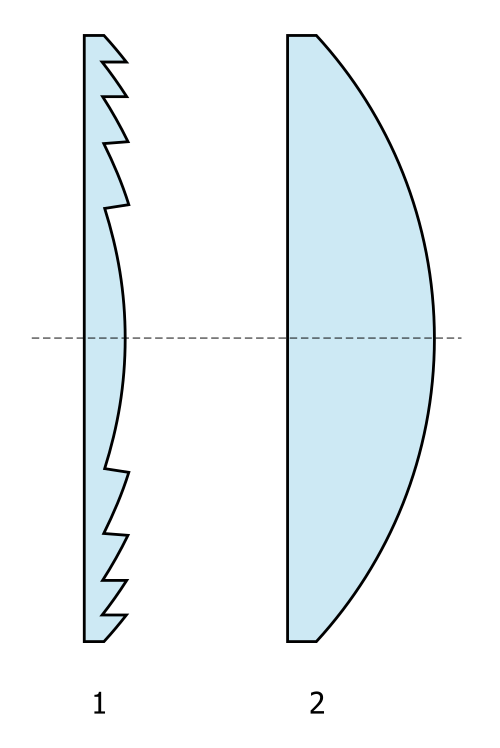
- “Describe construction of a Fresnel lens and its applications”: Fresnel lens is constructed as a series of concentric rings of surfaces angled to focus light. The way these surfaces are angled is as if you took a regular lens and keep only the surfaces, getting rid of bulk of the material between the two surfaces. The illustration of the cross section of a Fresnel lens (“1”) and a regular converging lens (“2”) on the right (from Wikipedia page) shows the result. The main advantage of Fresnel lens is the focusing power you can obtain for a large lens with a much thinner material. You have seen in the video that Fresnel lens was used for a big screen TV. Fresnel lenses are also used for construction of lighthouses and in different parts of automobiles (headlight for focusing the light from lamp, and in some large vehicles for reduction of blindspot by building a diverging Fresnel lens into rear window). You can also find small Fresnel lenses being sold as lightweight handheld magnifying glass. Solar-power hobbyists also find use for Fresnel lens (the video you have seen would be one less-practical extreme example of this application).
Chapter 12: Quantum Mechanics
Essay Assignment for “Chapter 12: Quantum Mechanics”
The conceptual foundation of quantum mechanics starts with the understanding that everything has both particle and wave characteristics. Light, which we have learned in the 19th century to think of as electromagnetic waves, interacts with matter as particles (this aspect of light is best illuminated in photoelectric effect). Normal matter particles, like electrons, can show interference phenomena as waves do.
While there is more “quantum weirdness” ahead that you may see in the future (particularly if you go on to major in physics), wave-particle duality is a good, solid foothold you can rely on (you can understand more abstract and mathematical aspects of quantum mechanics better, if you understand this one thing). It is not easy to find good videos on quantum mechanics (I’ve taken care to avoid any “popular-science” flavored videos which add more heat than light to the discussion), but I hope below two videos will help solidify your understanding of quantum mechanics better.
Please give them a watch, and answer below two questions. The first video is an illustration of photoelectric effect (but you’ll need to read about the photoelectric effect in the textbook), and the second video is a short lecture on electron interference:
- The first video shows a demonstration of photoelectric effect, which shows ultraviolet light has enough energy to free electrons from a zinc metal surface, but visible light does not. Explain how this demonstrates the relationship between photon energy and frequency given in Section 13.2 The Photoelectric Effect given in your textbook. Explain any new quantities or physical constants in your answer.
- Wave-particle duality is one of the more difficult modern physics concepts to fully grasp (Ever had that annoying friend who would answer a question like “Do you want waves or particles?” with a “Yes”?). But a good place to start gaining understanding is by pointing out key experimental features which illustrate particular aspects. In electron double-slit interference experiment (described in the second video), name at least one feature of the experiment that highlighted electron’s wave aspect, and name at least one feature of the experiment that highlighted electron’s (continuing) particle aspect. Give brief explanations for the features.
As you answer, make sure to answer both questions above. This is a peer-graded assignment, so please make sure your peers can understand what you wrote (you yourself will review answers by 3 of your peers).
To make a submission, click on “Submit” button at the top of the page. I encourage you to use the “Text Entry” option to type in your answers. Other submission options are enabled in case you need to include a diagram or a photo, but the text entry option is what I recommend. (Note: If you need to change anything in your submission, you can click on “Re-Submit” button to replace your previous submission.)
Peer Grading for “Chapter 12: Quantum Mechanics” Essay Assignment
Following are model answers to the questions in Essay Assignment for “Chapter 12: Quantum Mechanics”:
- Following are some important ideas in the explanation of photoelectric effect: (a) Light behaves like a particle in interacting with the electrons, and transfers energy to the electrons through “collision”. (b) If a single “collision” does not give an electron enough energy to escape the conductor, then electron loses any extra energy it gains quickly. That is, an electron cannot escape the conductor through multiple collisions with light particles. With these ideas in mind, what the demonstration shows is light particles (“photons”) of light with high frequency (ultraviolet light has higher frequency than visible light) has enough energy to eject the electrons, but photons of light with low frequency do not have enough energy. This relationship is expressed quantitatively as:
 where h is Planck’s constant (new constant defined in quantum mechanics) and f is the frequency of light.
 - Here are the lists of wave-like properties and particle-like properties. First, the wave-like properties (with explanations):
- diffraction (the spreading of the wave after passing through the slit): waves bend around obstacles (but particles could also change trajectory after bouncing from walls of slits)
- interference (alternating bright and dark fringes due to constructive and destructive interference between two slits): waves follow superposition principle, making in particular destructive interference possible; particles do not cancel each other out.
- wavelength (as illustrated in the interference phenomenon): unless something has a wave-like property, you can’t talk about its wavelength; the distance between bright and dark interference fringes are related to the electron wavelength (which is related to its momentum through de Broglie relation,
 )
)
- they are electrons: from the time of its discovery, it had every indication of being a particle (for example, having a definite charge to mass ratio; it’s hard to see how this property would fit with a wave model of electron).
- how they are detected: each time an electron is detected, the detector registers it in one location, not smeared out as a spread-out wave would be.
- how they are detected, part 2: not only is the electron detected as a particle at the screen, but if additional detectors are placed to measure electron position while the electron is moving from the slits to the screen, it is still detected as a particle in this case also, in the middle of its trajectory, not just at the end point.
Chapter 13: Special Relativity
Essay Assignment for “Chapter 13: Special Relativity”
The most subtle and consequential effect of special relativity is that we have to give up what we think of as absolute simultaneity (two things happening “at the same time”) and get used to the idea of relative simultaneity: two events that happen “at the same time” (but separated by some space) for you do not necessarily happen at the same time for other observers. They happen “at the same time” for other observers, if they are at rest relative to you. Two observers that are moving relative to each other will disagree on which two events (separated by some space and/or time) were simultaneous. While more flashy effects like time dilation and length contraction get more attention in special relativity, this relativity of simultaneity underpins all proper understanding of special relativity.
I quote from David Griffiths’ Revolutions in Twentieth-Century Physics:
Of course, it is always possible to be mistaken about simultaneity. If you happen to be standing at the rear end of the car, you may hear buzzer b before you hear buzzer a [buzzer a is placed at the front of the car and buzzer b is placed at the end of the car], just because the sound gets to you more quickly. It doesn’t take an Einstein to figure that out—obviously you need to correct for the time it took the news to reach you, whether it comes by sound, by light, or by Federal Express. We use the word observation (by extension observe and observer) to denote what you get after you have made the necessary correction for the time it took the data to reach you. What you observe, then, is not at all the same as what you see or hear.
For example, when you look up at the night sky, the light you see left the Moon 1.3 seconds ago, it left Jupiter around 40 minutes ago, it left the star Sirius 8.6 years ago, and it left the Andromeda galaxy 2.5 million years ago. You’re not seeing distant objects as they are in 2013 [… when the book was published], but as they were at various times in the remote past. If you want to know what’s happening up there right now, you’re going to have to wait for the news to get here. To observe the night sky (in the technical sense), you would assemble all that information as a reconstruction, after the fact. An observation can be made only when all the data are in.
Relativity has to do with what you observe. We are talking about real effects, not accidental appearances. Einstein liked to say that all the conceptual difficulties of special relativity derive ultimately from the relativity of simultaneity. It is subtle and counterintuitive, so be on guard!
To help you develop some sense around these conceptual issues, I have below a series of videos from minutephysics (a guy on YouTube who makes really short videos on physics) building up to a description and solution of what he calls “twins paradox.” Please give them a watch and answer one of below two questions.
- Give a description of the “twins paradox”. What is the setup, and which aspect of the setup is considered “paradoxical” (by those who don’t understand special relativity)? If you feel adventurous, try giving a resolution of the twins paradox, in your own words.
- The premise of the original Planet of the Apes (the book) is that the astronauts are able to be personally present on the Earth centuries later because they traveled to Betelgeuse (a star 430 light-years away) at a relativistic speed, and also returning at a relativistic speed, they aged much slower than the rest of the Earthlings (who would have been about 900 years old, if they survived). Describe a conversation that might take place between the astronauts and the Earthlings on their trip to Betelgeuse and on the trip back. For the simplicity of plot, assume existence of a magical communication device (call it an ansible) which allows for an instantaneous (i.e. “simultaneous”) communication regardless of distance.
Please answer at least one of two questions above. This is a peer-graded assignment, so please make sure your peers can understand what you wrote (you yourself will review answers by 3 of your peers).
To make a submission, click on “Submit” button at the top of the page. I encourage you to use the “Text Entry” option to type in your answers. Other submission options are enabled in case you need to include a diagram or a photo, but the text entry option is what I recommend. (Note: If you need to change anything in your submission, you can click on “Re-Submit” button to replace your previous submission.)
Peer Grading for “Chapter 13: Special Relativity” Essay Assignment
Following are model answers to the questions in Essay Assignment for “Chapter 13: Special Relativity”:
- This is the “paradox” in the “twin paradox”: From the perspective of one of the twins, the other twin is the one moving. That is, for the twin on Earth, it’s the twin who is traveling that is moving, and for the twin who is traveling, it is the Earth twin that is moving (and since motion is relative, there is no such thing as “absolute rest,” and you can’t say that it’s the Earth twin that’s actually at rest—whether something is moving or not depends on the perspective, or “reference frame” of the observer). Time dilation says moving clocks run slow. So in the Earth twin’s view, the traveling twin’s clock is running slower (and the traveling twin is aging slower). But in the traveling twin’s view, the Earth twin’s clock is running slower (and the Earth twin is aging slower). So, who is right? When they get back together, who should be older? [The resolution of the paradox, which is explained in the video, is that the situation is not completely symmetric. The velocity of the Earth twin is not changing, but the velocity of the traveling twin changes as they turn around for the return trip. This makes Earth twin’s perspective “more correct” in some sense, and the traveling twin is actually younger (aged slower). The video does a better job of explanation, although it is quite a bit mathematical.]
- If the astronauts are traveling toward Betelgeuse at 99.9% of speed of light, their Lorentz factor will be about 22, meaning the distance of 430 light-years will be length-contracted in the astronaut frame (to only about 20 light-years) and they can make the journey in their lifetime, if they start young. As the astronauts travel towards Betelgeuse in their 20-year mission, if they remain in contact with Earth through ansible, they will find that the time passes more slowly on Earth. Earth clock, from their perspective, is time-dilated by a factor of 22, so as 20 years pass on the spaceship, they will see only about 1 year pass on Earth (so the conversations would involve change of season and holiday celebrations, but depending on the year, they wouldn’t hear about presidential elections). When they come to a stop at Betelgeuse, that’s when suddenly—from the astronauts’ perspective—about 430 years of time passes for Earth, and depending on when the apes take over the Earth, the astronauts can no longer contact Earth (and they certainly wouldn’t care about who the next president was, given that everyone they knew would be dead now). When they decide to come home, the moment they reach their cruising velocity (99.9% of speed of light, coming back home) is when another 430 years of time has passed for Earth, and this time, the apes will definitely be ruling the Earth and the astronauts can give their ape future-colleagues a 1-year heads-up on their arrival. [Note: Most science fiction authors don’t get this right. Even Orson Scott Card, who tried to make Ender’s Game as hard-SF as possible, got this aspect of relativistic communication wrong when he describes Ender and Valentine’s relativistic journeys.]
Chapter 14: Nuclear and Particle Physics
Essay Assignment for “Chapter 14: Nuclear and Particle Physics”
As I said in the Chapter 14 overview, there is much I wish we could cover in Chapter 14 that we cannot cover due to lack of time. Our goal in this essay assignment is to look at two phenomena that you may find relevant and interesting (O.K., one phenomenon that I hope you find relevant and interesting, and another phenomenon that I find relevant and interesting, in the context of modern physics research).
Part 1 – Radiation
Below videos cover “radiation”. Please give them a watch (two questions follow after the videos).
Lest I leave you only with positive impressions of radiation, I am including the below video as part of this assignment. All the hysteria and NIMBYism aside, the dangers of nuclear radiation are real (lack of this realization led to some of early researchers in radioactivity not taking adequate precautions, as you read in the chapters). Below video is a sober look at the aftermath of Chernobyl accident, “the world’s worst nuclear disaster.”
Having watched above three videos, choose one of the below two questions to answer.
- How is nuclear radiation (aside from nuclear power generation or nuclear weapons) used in modern everyday life? Give two examples (preferably modern devices) and, for each example, explain in some detail what important role nuclear radiation serves in the functioning of the modern device. (Note: For a technical reason, X-ray does not qualify as “nuclear radiation”—X-ray device is an example of radiation producing machine, but it does not use radioactivity.)
- Why is nuclear radiation (and ionizing radiation, more broadly) dangerous? Explain the biological reasons for the dangers of nuclear radiation and what precautions may be taken, for those who need to work with (or in proximity to) nuclear radiation.
Please continue below, for the second question to answer for this assignment.
Part 2 – Neutrinos
After watching below videos, please answer Question 3 below.
- Briefly explain what neutrinos are and give some examples of important roles neutrinos play in modern physics research, explaining their roles in your own words. For the purpose of “modern physics research”, you may cite recent discoveries made with or made regarding neutrinos.
As you answer, please make sure to answer two questions (choice of one from Questions 1 and 2, and Question 3 as the second question you answer). This is a peer-graded assignment, so please make sure your peers can understand what you wrote (you yourself will review answers by 3 of your peers).
To make a submission, click on “Submit” button at the top of the page. I encourage you to use the “Text Entry” option to type in your answers. Other submission options are enabled in case you need to include a diagram or a photo, but the text entry option is what I recommend. (Note: If you need to change anything in your submission, you can click on “Re-Submit” button to replace your previous submission.)
Peer Grading for “Chapter 14: Nuclear and Particle Physics” Essay Assignment
Following are model answers to the questions in Essay Assignment for “Chapter 14: Nuclear and Particle Physics”:
- Excluding nuclear (fission) power generation, nuclear weapons, and X-ray imaging, following are some examples of uses of nuclear radiation in everyday life. First from the textbook section (15.6 Medical Imaging and Diagnostics): (1) radiopharmaceuticals, where a radioactive nuclide in a compound is used to tag the molecule for tracking as it moves through the body, because the radiation emitted by the radioactive nuclide can be detected with detectors placed outside the body; (2) as an example of radiopharmaceutical, use of radioactive iodine to image the thyroid; (3) as another example of radiopharmaceutical, use of radioactive thallium in thallium-chloride salt to image the cardiovascular system; and (4) positron emission tomography (PET), which uses beta+ emitters. And from one of the videos: (5) smoke detectors (using americium-241 for ionizing air, which then can be used to detect for presence of smoke particles), and (6) radiotherapy used in cancer treatment (gamma rays used to selectively kill cancer cells). Video also mentions PET scan, which is not repeated in this list. There are other uses of radiation that you may have found in your own research, such as radiation-powered exit light. In the old days, radium was used for similar purpose, but as dangers of radiation were better understood, these uses have stopped (read more about radium girls). [Radioactivity, of course, is more widely used in research setting; I did not include any of them in the list above, but peer graders may use their judgment on whether research-setting use qualify as “modern everyday life”.]
- Ionizing radiation (and all nuclear radiation is ionizing radiation, although some ionizing radiation is not nuclear radiation) is dangerous because the particles in ionizing radiation (whether it’s helium-4 nucleus, electron, or photon) have enough energy to remove electrons from atoms and molecules, ionizing them. Once ionized, these ions can undergo energetic chemical reactions, and if these happen inside our body, these chemical reactions can damage DNA and other cell structure. The precautions that may be taken can be memorized with the mnemonic, time, distance, and shielding. “Time” means to limit the length of time of exposure to ionizing radiation, since the total dose received is product of rate of exposure (determined by activity level of radioactive sample and other factors) and duration of exposure. “Distance” means to establish a safe distance. Many ionizing radiations follow inverse-square law rule, meaning if you increase your working distance from the source by a factor of 2, your exposure rate decreases by a factor of 4. “Shielding” reminds that some ionizing radiation can be shielded with material placed between the radioactive source and you. Alpha particles can be most easily shielded (a few centimeters of air will do); beta particles can also be relatively easily shielded (a thin metal plate will do; higher-energy beta particles require more care to avoid secondary radiation). Gamma rays are like X-rays and require thick layers of lead shielding for substantial reduction of exposure rate. [The order they are listed here are, BTW, the recommended order of priority: first, limit how long you must be exposed to ionizing radiation, but if you must be exposed, then do it at the farthest distance you can be exposed while still doing what needs to be done, and if neither is possible, then try blocking the radiation with shielding. But shielding is the least effective method of protecting yourself and it is only a method of last resort when neither “time” nor “distance” are practical.]
- Neutrinos are electrically neutral particles that are in other ways similar to electron (in technical terms, neutrinos are leptons). They are special in how infrequently they interact with other matter (because they don’t interact by strong nuclear force or by electromagnetic force, only interacting by weak nuclear force, and presumably gravitational force). Neutrinos have been used to verify standard models of solar dynamics (neutrinos are produced in fusion reactions within the Sun), and neutrino oscillation (proposed and verified in connection with “solar neutrino problem”) has provided greater insight into elementary particles. Astrophysicists think they can use neutrinos detected from elsewhere in the universe to gain an understanding of cosmology (other than some observations of neutrino burst from supernovas, I think these are still research to be completed, if ever).